

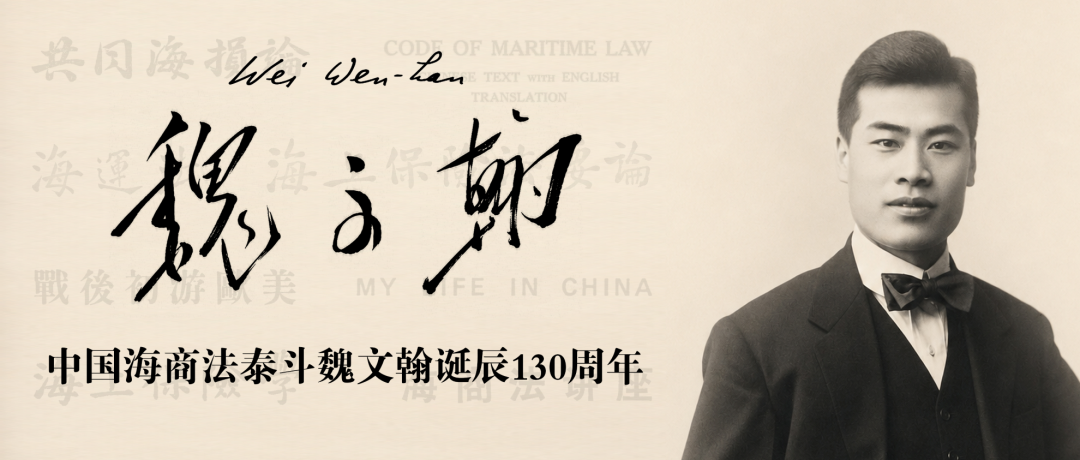
编者按:中国海商法泰斗魏文翰教授生于1896年,2026年是其诞辰130周年。我们将陆续推送关于魏文翰的文献资料,包括其本人著作、他人回忆文章以及其他相关文献。
11月15日至12月1日,国际劳工组织海事预备技术会议(Maritime Preparatory Technical Conference)在丹麦哥本哈根举行。魏文翰被推举为中国代表团船东代表。自11月7日从重庆启程,先后途经印度、伊朗、埃及、希腊、意大利、法国、德国,抵达丹麦。会议结束后,又陆续前往瑞典、挪威、英国、美国,直至1946年7月7日返回上海。此后魏文翰写成《战后初游欧美》,于《旅行杂志》1946年第20卷第9期至第12期连载。
海事预备技术会议资料对魏文翰的介绍为:“Mr. WEI Wen-han, Managing Director of the Chung Hsing Steamship Co.; Director of the Ming Sung Industrial Co.(魏文翰,中兴轮船公司常务董事,民生实业公司董事)”。会议期间,魏文翰参加了以下三个委员会:
(1)工资、工时及配员委员会,作为船东委员;
(2)社会保险委员会,作为船东替补委员;
(3)入职、培训及晋升委员会,作为船东替补委员。
魏文翰自传回忆:本次会议专门为调和劳资双方的利益冲突,让海员与资方就工资标准、伙食和其他福利反复磋商。每个海运国家均须派出三个代表团,分别代表海员、船东、政府。如果海员与船东争执不下陷入僵局,政府官员便出面缓和。据此与会代表分成三组,各自制定本方方案和策略。会议既有全体大会,也有规模较小的讨论小组。工资标准在所有议题中最为棘手,双方激烈争论、反复交锋。想到在外国船舶工作的中国海员的薪酬远低于当时欧洲工人的标准,却无代表出席,会上也无一句话提到此种不公平的歧视,魏文翰的民族感情受到激发,举出多个事例说明中国海员工作效率之高、面对风暴之勇敢,以及忍受艰苦之坚韧。
1946年6月6日至29日,国际劳工组织第28届(海事)会议[The Twenty-eighth (Maritime) Session]在美国西雅图举行。卢作孚为中国代表团船东代表,魏文翰为顾问及替补代表,会议资料对其介绍如下:“Dr. WEI Wen-han, General Manager of the Chung Hsin Steamship Company.(魏文翰博士,中兴轮船公司常务理事。)”魏文翰参加了以下四个委员会:
(1)遴选委员会,作为船东替补委员;
(2)社会保障委员会,作为船东委员,张宗植为其替补委员;
(3)起居舱室委员会,作为船东委员;
(4)工资、工时及配员委员会,作为船东委员。
6月10日上午10时举行的第5次会议上,魏文翰作了专题发言。1946年6月12日《侨声报》对此曾有报道,题为“魏文瀚氏大声疾呼 中国需船三百万吨 海事分配不均漠视我权益 日本原有吨位应由我填补”。本期推送此次发言的英文原文及中文译文。
往期回顾:
国际劳工组织第28届(海事)会议会议记录
读过局长报告以后,不能不对国际劳工局工作人员所做的认真而全面的工作心怀感激。这份报告内容翔实,十分引人入胜。正是由于国际劳工局坚持不懈的努力,1920年已经开始的良好工作才得以在战争期间继续进行。也正是由于同样不懈的努力,哥本哈根会议终于得以召开,本届会议也得以举行。对于这项出色的工作以及这份报告,我谨代表本组表示赞赏和感谢。
报告虽然十分全面,也很有意思,但我注意到,代理局长用了相当多的篇幅讨论一个极为重要的问题,即世界商船吨位的分配。这确实是一个非常重要的问题。关于这一问题,我注意到,代理局长提到了若干国家的需要,但中国的需要却完全受到忽视,在他对这一重要问题的考察中根本没有得到反映。此外,在他所引用的数据中,只有完整统计表中的一处列出了中国的数据。我经过核查,发现这些数据是错误的,因而也具有误导性。
我认为,我们的海事会议并没有就这一重要问题作出决定,因为严格说来,这一问题不属于本次会议的职权范围。不过,代理局长也提到,这一问题与劳动者的状况存在联系。因此,我再说一遍:据我所知,会议并未就这一问题通过任何决议或作出任何决定,但我仍想对此发表一些意见。
首先,我要指出,报告中关于中国商船吨位的数据并不正确。报告第13页有一张题为“1939年与1945年世界商船吨位分布”的表格。表中称,1939年中国拥有65艘船舶和若干载重吨位;1945年则拥有49艘船舶,约157,000吨。
作为一个航运界人士,我了解中国的实际情况。我承认,中国在战争期间的船舶吨位当然很小,但我要指出,大约100吨至1,000吨的船舶合计约有200艘,其总吨位约为570,000总吨。战争期间,沿海船舶和海船即使不是全部,也有绝大多数遭到毁坏,只剩下一些内河船舶,总吨位甚至不足100,000吨。但无论采用表中所列数字,还是采用我刚才所说的数字,我都想向各位代表说明:这一吨位实在太小,根本不能满足中国对航运运力的需要。
我相信诸位都知道,中国多年来同不同国家订有条约,中国的内河和沿海水域都可以由悬挂外国旗帜的船舶航行。因此,中国境内曾有许多外国公司。它们在中国从事国内运输,不仅经营沿海航运,而且深入内陆河流的偏远地区。当然,这些外国船舶的吨位也承担着满足中国运输需要的作用。把这些吨位同中国本国船舶吨位合并计算,总数便超过了100万总吨。此外,日本船舶过去经常驶往中国沿海,其船舶数量和吨位也相当庞大;遗憾的是,我目前没有可供引用的统计数字。还有许多国际班轮和商船来到中国沿海进行贸易。因此,如果对中国的需要作一个大致估计,中国所需的航运运力至少应在200万至300万总吨之间。
我记得,战前中国的对外贸易中,进口商品价值约为5亿美元,出口额则大约相当于进口额的一半,或者不到三分之二。当然,中国人口接近4.5亿,这意味着平均每人所对应的对外贸易额,按中国货币计算,只有一两元,这是非常低的。众所周知,中国在战争期间同日本进行了抗战,并最终赢得了各国的尊重。过去那些使外国航运公司能够在中国内河和沿海经营运输的所谓通商条约,也已经得到调整。
现在,中国国内内河航运已处于同其他国家相同的地位,也就是保留由中国国民经营。因此,中国必须依靠自己来满足运输需要;同时,通过同友好国家签订的条约,中国还必须增加自己的船舶吨位,以满足包括内河、沿海和近海航运在内的各种需要。作为第一阶段,中国所需船舶吨位就应达到200万至300万总吨。
战后,中国人人都赞成重建国家;这是中国当前并将继续坚持的共同目标。为了提高广大人民的生活水平,假如中国人均对外贸易额再增加一两美元,按照战前中国货币及其购买力计算,中国的对外贸易额便将翻一番,而这也意味着中国需要增加同等规模的航运运力。就中国的货主和航运界而言,他们当然希望人均对外贸易额的增长不限于一两美元。因此,中国真正需要的航运运力,可能是上述200万至300万总吨的两倍,甚至三倍或四倍。这是一项非常严肃的判断。
然而,我遗憾地指出,尽管国际劳工局工作人员十分勤勉,工作也十分出色,但报告却完全忽视了这一重要需要。报告列出了少数其他国家的需要,却遗漏了中国的需要,而中国在世界事务中的地位绝非无足轻重。因此,我并不完全理解报告第18页最后一段所说的:“因此,必须期待通过国际磋商与合作来解决这些问题。”这是否意味着,第13页所列的各国吨位比例今后仍将大体维持不变?果真如此,那么在世界商船吨位分配问题上,中国的需要就被完全忽略了——当然,我相信这并不是报告的真正意图。
毕竟,我必须说,中国在一百年或八十年前错过了班车,如今仍然落在后面。但是,我们正在竭尽全力赶上这班车。我们赞成自由贸易和自由商业。我不认为应当对一个国家的民族发展愿望施加不当限制,特别是在这个国家正诚实努力、力求改善人民个人生计的时候。我还注意到,报告关于世界商船吨位分配的表格中当然没有列出日本的吨位。但是,日本是中国近邻,而中国又是对日作战的重要力量。因此,我们自然认为,中国至少应当分得日本过去在世界某些地区从事贸易时所拥有或控制的一部分船舶吨位。所以,我们认为,这份报告虽然体现了出色的工作和良好的意图,却完全忽视了中国的需求。我在此提请局长办公室以及各位代表注意这一点。在分配世界商船吨位时,应当认真考虑中国的需要。我确实希望,中国的需要不要再受到完全忽视。
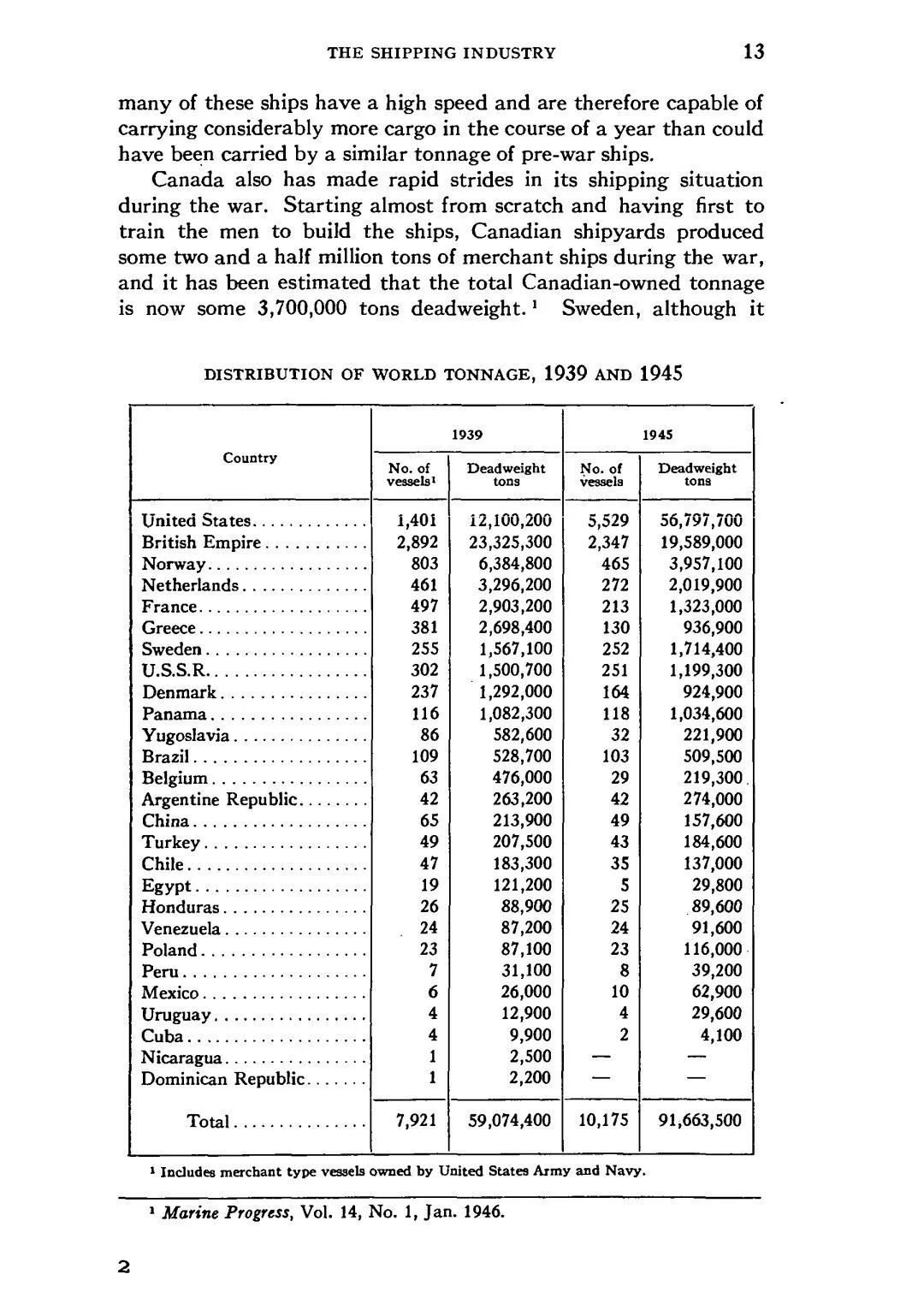
魏文翰发言提及的报告第13页
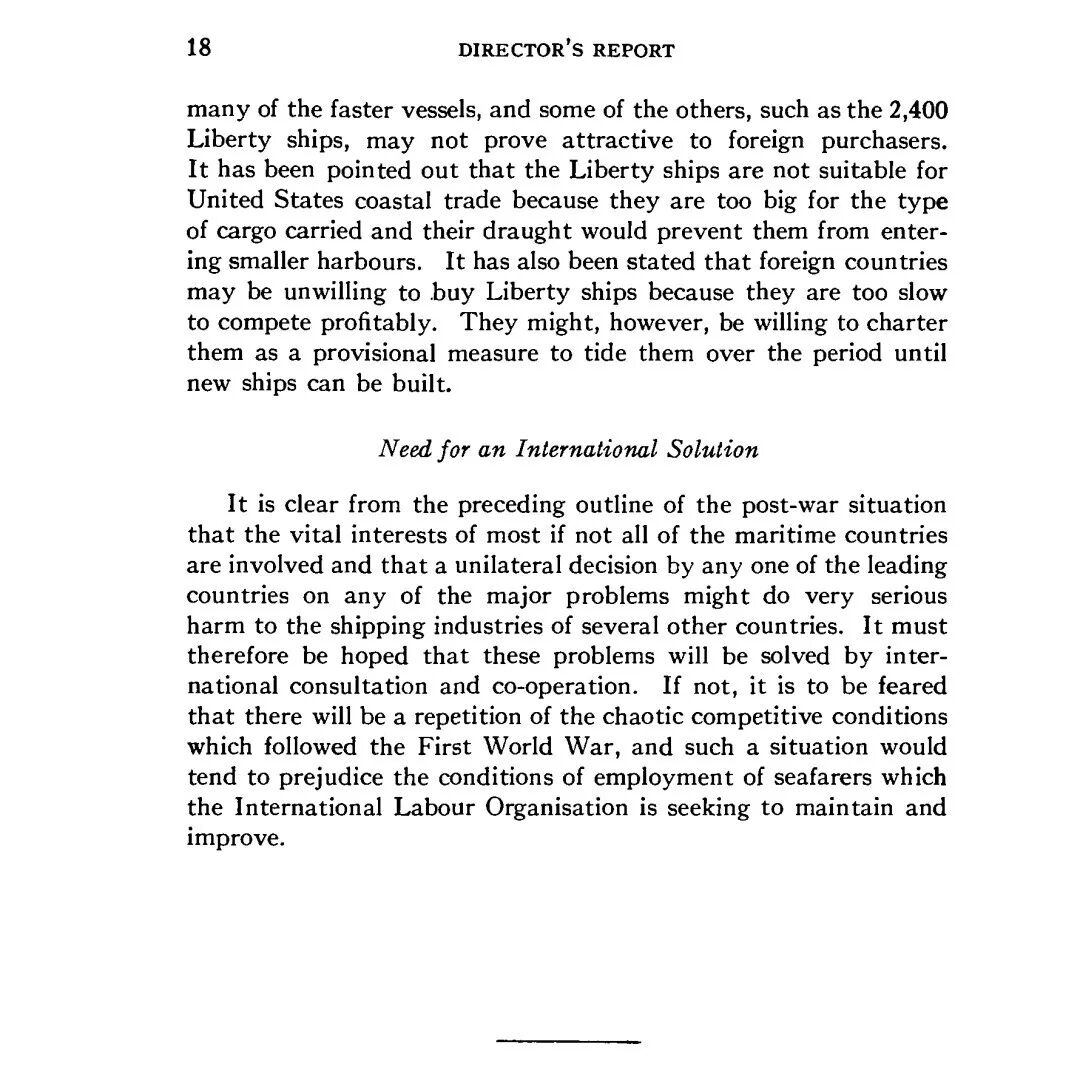
魏文翰发言提及的报告第18页
In reading over the Director’s Report, one cannot but have a feeling of indebtedness for the good and thorough work done by the staff of the International Labour Office. It is very informative and very interesting. It is through the untiring effort of the Office that the good work already started in 1920 was kept up during the period of the war. Also, through that same untiring effort, finally, the Copenhagen Conference was called and this present Conference takes place. For this splendid work and Report, I, on behalf of my group, express my appreciation and gratitude.
While the Report is very comprehensive and interesting, I find one of the most important subjects, on which the Acting Director chooses to spend quite a good deal of time and pages, is the distribution of the world’s tonnage. That is a very important subject. On that subject, as I notice, the Acting Director mentions the needs of a number of countries, but the need of China is completely ignored and is entirely missing from his considerations on this important subject. And also, in the figures he quotes, in only one place does he quote figures for China, in the full table, and I have checked up and found that these figures are erroneous, and therefore misleading.
It is on this important subject, on which I believe no decisions were taken in our Maritime Conference, because, indeed, it is outside the realm of the Conference, although the Acting Director mentioned its connecting relationship with the conditions of the workers, I repeat, on this subject, on which as far as I know there were no resolutions passed or decisions made, I would like to make comments and to say a few words.
In the first place, I would like to point out that the figures mentioned in connection with China’s shipping tonnage are not correct. On page 13, you will find a table. In that table it says, “Distribution of World Tonnage, 1939 and 1945”. In the year 1939 it mentions China as having 65 ships and so many deadweight tons, and in 1945, similarly, 49 and about 157,000 tons.
Being a shipping man and knowing the situation in China I admit that, of course, the tonnage in China during the war was very small, but I must say that the vessels of about a hundred to a thousand tons altogether totalled about two hundred. The total amount of tonnage, then, was about 570,000 gross tons. During the war, most, if not all, of the coastal vessels, sea-going vessels were destroyed. Only some river craft were left, something even under one hundred thousand tons. But no matter which figure it may be, whether the figure put down in the table or the figure I have just quoted, I want to make clear to my fellow delegates that this tonnage is very small. It does not satisfy the need for shipping space in China.
I am sure you all know and are fully aware that China for a number of years had treaties with different nations and that the Chinese inland rivers as well as her coast could be navigated by vessels flying the flags of other nations. Therefore, there have been a number of foreign companies in China. They are engaged in domestic trade in China, not only on the coast but also in the far away part of inland rivers, and of course this tonnage also serves the needs of China. And that, when we add it together, comes to a number, together with China’s own tonnage, that exceeds more than one million tons. Then, there was the Japanese tonnage coming to the China coast very often, and that would constitute another large figure of ships and tonnage, for which I regret I have no statistics available at present. And then, there are a number of international liners, traders, that come to China coasts to trade. Therefore, the needs of China, if you are going to make an approximate estimate, should be no less than between two or three million tons of shipping in gross tons.
I remember, before the war, the foreign trade of China; we imported something like five hundred million dollars’ worth of merchandise, and the exports were about half or less than two thirds of that amount. Of course, with the population of China close on 450 million, that means each person has only one or two dollars, Chinese currency, in foreign trade, which is very little. China, during the war, put up a fight with Japan, as you all know, and finally gained the respect of the different nations, and those so-called trade treaties, which give rise to foreign shipping companies carrying on interior river trade in China and the coastal trade of China, were adjusted.
Now, the position of the Chinese domestic inland shipping is put on the same basis as any other nation’s, but reserved to the nationals of China. Therefore, China is bound to fill the need herself and, through the treaties with friendly nations, China has to increase her tonnage to look after her own needs, including inland rivers, coastal and the near seas, and as a first stage that would mean two or three million tons.
Yet in China, after the war, everybody is in favour of the reconstruction of the country; that is the one ambition that China has and will continue to have. If China, to elevate the living conditions of the people of the general masses, should increase her foreign trade, per capita, by another one or two dollars, then, on the basis of the currency in China before the war, the purchasing power of the dollar in China before the war, that would double her foreign trade, and that would require that much more shipping space for her needs. As far as the shippers of China are concerned, they would prefer the increase of foreign trade per capita not to be limited to one or two dollars. Therefore, there is really a need in China of twice that two or three million tonnage of shipping space, or of three or even four times that tonnage. That is a very serious statement.
Yet I regret to say that this important need—with all due respect to the diligence and good work of the staff of the Office—is completely ignored in the Report. The needs of a few other countries are given; but the need of China, which is also not in an insignificant position in world affairs, is omitted. Therefore, I do not fully understand what the Report implies, when it mentions on page 18, in the last paragraph, “It must therefore be hoped that these problems will be solved by international consultation and co-operation.” Does it mean that the position as shown on page 13 is to be maintained in more or less that ratio? If that is so, it completely ignores the needs of China—which I am sure is not the real intention of the Report—for the distribution of tonnage.
After all, China, I must say, missed the bus about a hundred years ago, or eighty years ago, and she is still lagging behind, but nevertheless we are doing our best to catch the bus and we are for free trade and commerce, and I do not believe undue restrictions should be placed on the national aspirations of a country, particularly when that country is trying to make an honest effort for the betterment of the individual livelihood of the people. I also found in the Report, in this table of distribution of tonnage, that the tonnage of Japan was of course not listed, but Japan being such a close neighbour to China, and China having been such a fighting factor with Japan, naturally we feel that China should have at least a share of that tonnage which was owned or possessed by Japan in trading in given parts of the world, and therefore we feel that this present Report, with all due respect to the good work and good intentions, has completely ignored China’s want and need, to which I just call the attention of the Director’s Office, and also of my fellow delegates. Some thought should be given to the distribution of the world tonnage, and I do want the need of China not to be completely ignored.